Here’s a stat that should wake you up: Google Local Service Ads for realtors generate an average cost per lead that’s 40% to 60% lower than traditional search ads. Yet most agents either ignore them completely or set them up wrong and quit after two weeks. If you’ve been pouring money into online advertising without seeing consistent listing appointments on your calendar, Local Service Ads might be the missing piece you didn’t know existed. And if you’ve tried them before with mediocre results? Stick around. The platform has changed significantly heading into 2026, and the agents who adapt are going to dominate their local markets.
Want seller leads on autopilot? ListingLeads.io combines Google Ads, home value tools, and AI follow-up to book listing appointments while you sleep. Book your free strategy call now →
What Are Google Local Service Ads for Realtors, and Why Should You Care?
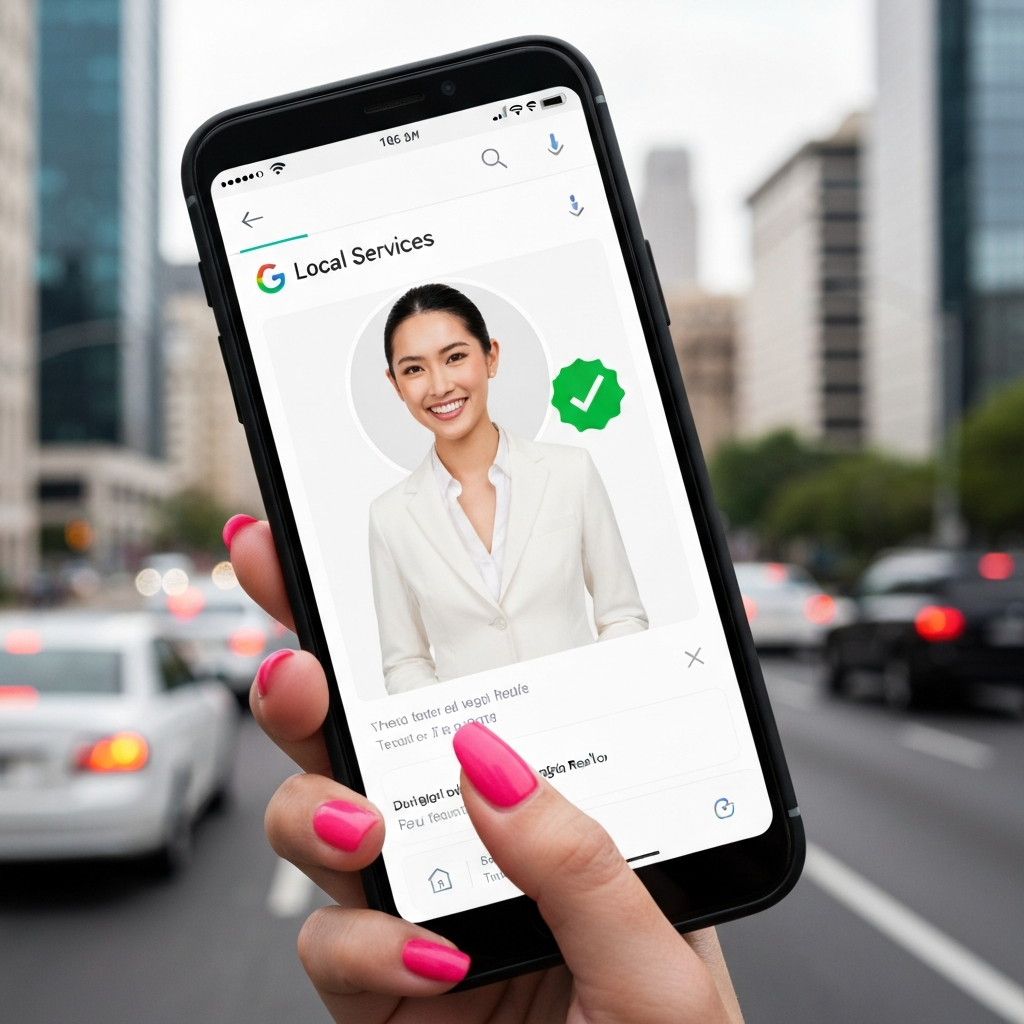
Local Service Ads (LSAs) are the listings that appear at the very top of Google search results. Above the traditional pay-per-click ads. Above the map pack. Above everything. They show up with a green “Google Screened” badge next to your name, which instantly tells potential sellers that Google has verified your license and background.
Think about what that means for a homeowner who’s Googling “best realtor near me” or “top listing agent in [your city].” They see your face, your reviews, your Google Screened badge, and a button to call or message you directly. No clicking through to a landing page. No filling out a form they’ll forget about. Direct contact, right from the search result.
The best part? You only pay when someone actually contacts you. Not when they see your ad. Not when they click. Only when they call, message, or book directly. That’s a fundamentally different model than traditional PPC, and it’s why agents who understand it are getting seller leads for $15 to $35 each in many markets.
If you want a deeper look at how paid advertising fits into a complete seller lead strategy, check out this guide on 11 ways Google Ads generate seller leads in real estate. LSAs are one powerful channel in a much bigger system.
Tip #1: Get Google Screened Before Your Competition Does
The Google Screened badge isn’t optional. It’s the entire foundation of Local Service Ads for real estate agents. Without it, you literally cannot run LSAs. And here’s what most agents don’t realize: the verification process can take two to four weeks, sometimes longer if there are issues with your license documentation.
Start the process now. Not next month. Not when you “have time.” Right now.
You’ll need to provide your real estate license number, pass a background check, and verify your business insurance. Google partners with third-party verification companies like Pinkerton to handle the background screening. The process is free, but it requires attention to detail. One wrong digit on your license number can delay everything by weeks.
Pro tip: If you’re on a team, each agent who wants to appear in LSAs needs to be individually screened. The team leader’s badge doesn’t cover everyone. Get your whole team through the process simultaneously so you’re all live at the same time.
Tip #2: Obsess Over Your Reviews (Because Google Does)
Your review count and average rating are the single biggest factors determining whether your LSA shows up above your competitors. This isn’t speculation. Google’s own documentation confirms that reviews are the primary ranking signal for Local Service Ads.
Here’s what I see constantly: an agent with 12 reviews at 4.8 stars wondering why they’re not getting leads, while their competitor with 87 reviews at 4.7 stars is getting three to five calls per week. Volume matters. A lot.
Make review collection a non-negotiable part of your closing process. Every transaction should result in a Google review. Every single one. Create a simple text template you send to clients the day after closing. Something personal, not a generic “please leave a review” email that gets buried in their inbox.
And respond to every review you receive. Every five-star praise. Every occasional four-star with constructive feedback. Google tracks your responsiveness, and potential clients notice it too. A thoughtful reply to a review tells homeowners you actually care about the experience, not just the commission check.
Tip #3: Set Your Budget Strategically (Not Emotionally)
One of the most common pay-per-click advertising mistakes agents make is setting their budget too low and then complaining that ads “don’t work.” LSAs are no different.
Google lets you set a weekly budget for LSAs. In most mid-sized markets, you’ll want to start with at least $150 to $250 per week to get meaningful data. That might sound like a lot until you do the math. If you’re paying $25 per lead and you convert just one out of every 15 leads into a listing appointment, and one out of every three appointments becomes a signed listing agreement, you’re looking at roughly $1,125 in ad spend to win a listing.
On a $400,000 home at a 2.5% commission, that’s a $10,000 payday from a $1,125 investment. Nearly a 9x return.
That said, don’t just throw money at it and hope. Track your numbers religiously. Know your cost per lead, your contact rate, your appointment rate, and your close rate. If you’re not sure how to structure this tracking, see how ListingLeads.io builds this system for agents so nothing falls through the cracks.
Tip #4: Respond to Leads Within 60 Seconds (Yes, Really)
This is the tip that separates the agents who make money with LSAs from the agents who waste money on them.
Speed to lead is everything. Research from InsideSales.com shows that responding to an online lead within five minutes makes you 21 times more likely to qualify that lead compared to waiting 30 minutes. And with LSAs specifically, Google actually tracks your responsiveness and uses it as a ranking factor. Slow responders get fewer leads. Fast responders get more. It’s that simple.
But let’s be honest. You’re not sitting by your phone all day waiting for it to ring. You’re at listing appointments, showing homes, negotiating offers, picking up your kids from school. You’re a real person with a real life.
This is exactly why AI-powered follow-up automation exists. When a lead comes in from your LSA and you’re in the middle of a listing presentation, an AI system can instantly respond, qualify the lead, and even book an appointment on your calendar. By the time you’re back in your car, you’ve already got a new listing appointment scheduled for tomorrow afternoon.
That’s not science fiction. That’s what agents using ListingLeads.io’s AI follow-up system experience every day.
Tip #5: Dispute Invalid Leads (Most Agents Don’t Know This)
Here’s a pattern interrupt for you: Google will give you money back for bad leads. Most agents have no idea this is even possible, and they’re literally leaving hundreds of dollars on the table every month.
Not every lead that comes through your LSA is legitimate. Some are spam calls. Some are people looking for a property manager, not a listing agent. Some are wrong numbers. Some are people asking about a rental, not a home sale. Google knows this happens, and they have a built-in dispute process.
Within the LSA dashboard, you can mark a lead as invalid and request a credit. Google reviews the recorded call or message (yes, they record the calls) and if they agree it wasn’t a legitimate real estate lead, they credit your account. I’ve seen agents recover 15% to 25% of their monthly spend this way.
Set a calendar reminder every Friday afternoon to review your leads from the past week and dispute any that don’t qualify. It takes ten minutes and can save you $100 or more per month. Over a year, that’s real money.
Tip #6: Optimize Your Business Profile for Seller Keywords
Your LSA profile has several fields you can customize, and most agents fill them out like they’re writing a grocery list. “Full service realtor. Buyer and seller representation. Residential real estate.” Boring. Generic. And it doesn’t help Google match you with the right searches.
Instead, think about the specific services sellers are looking for and make sure your profile explicitly mentions them:
- ▸ Home valuation and pricing strategy
- ▸ Listing and marketing your home for sale
- ▸ Expired listing specialist
- ▸ Relocation and downsizing assistance
- ▸ Pre-sale home preparation and staging guidance
The more specific your service descriptions, the better Google can match you with homeowners who are actively searching for a listing agent. Remember, you’re competing with every other agent in your area who has LSAs running. Your profile is your first impression. Make it count.
For more on creating assets that convert at a high level, take a look at these Google Ads real estate landing pages that convert. The same principles of specificity and clarity apply to your LSA profile.
Tip #7: Combine LSAs with Traditional Google Ads for Maximum Visibility
Here’s where most agents leave massive opportunity on the table. They treat Local Service Ads as an either/or decision. Either I run LSAs, or I run regular Google Ads. Wrong. The real power comes from running both simultaneously.
Picture this: a homeowner in your market types “sell my house fast in [your city]” into Google. If you’re running both LSAs and traditional search ads, you could potentially show up twice on the same search results page. Your LSA at the very top with your photo and Google Screened badge. Your regular search ad right below it. That kind of double exposure builds trust instantly. The homeowner thinks, “This agent must be the real deal if they’re everywhere.”
This dual strategy is particularly effective when your traditional ads point to a home value landing page where sellers can get an instant estimate of what their property is worth. The LSA captures the people who want to talk to someone right now. The search ad captures the people who want information first before picking up the phone.
Different buyers at different stages. You catch them all.
If you want to learn the fundamentals of doing this right, this breakdown of how to run Google Ads for real estate like a pro is a great place to start. And if you want to understand how to improve your numbers once you’re running ads, here’s a guide on boosting your Google Ads conversion rates.
Tip #8: Track Everything and Know Your Numbers
I saved this one for last because it’s the one agents most want to skip. Tracking isn’t sexy. Spreadsheets aren’t exciting. But knowing your numbers is the difference between gambling and investing.
At minimum, you should be tracking these metrics monthly:
- ▸ Total LSA spend
- ▸ Number of leads received
- ▸ Cost per lead
- ▸ Number of leads that became conversations
- ▸ Number of listing appointments booked
- ▸ Number of signed listing agreements
- ▸ Revenue generated from LSA-sourced listings
When you know these numbers, you can make informed decisions. Should you increase your budget? The data tells you. Should you focus more on improving your response time? The data tells you that too. Should you invest more in reviews? Again, the data.
If the idea of tracking all of this feels overwhelming, that’s exactly why many agents choose to work with a real estate PPC management company that handles the optimization and reporting for them.
Addressing the Two Biggest Objections
“I’ve tried online ads before and they didn’t work.”
I hear this constantly. And almost every time, the issue wasn’t the ads themselves. It was one of three things: the targeting was wrong, the follow-up was too slow, or there was no follow-up system at all. An ad can do its job perfectly by putting a motivated seller in front of you, but if nobody responds to that lead for six hours, they’ve already called the next agent on the list.
LSAs combined with proper AI follow-up solve the response time problem entirely. And the targeting issue? LSAs target by geography and service type, so the leads you’re getting are people in your area who specifically searched for real estate help. That’s about as qualified as an online lead gets.
“My market is different. This won’t work here.”
Your market isn’t as different as you think. People in every market Google “how to sell my house” and “best realtor near me.” According to the National Association of Realtors’ 2024 Profile of Home Buyers and Sellers, 96% of home buyers used online tools during their search. Sellers are increasingly doing the same research before choosing an agent.
In fact, agents in smaller markets often see even better results with LSAs because there’s less competition. In a major metro, you might be one of 40 agents running Local Service Ads. In a smaller market, you might be one of five. Or one of two. The math works in your favor.
Real-World Scenario: What This Looks Like in Action
Let’s walk through a hypothetical that’s based on real numbers we’ve seen agents achieve.
Sarah is an agent in a mid-sized Midwest market. She starts running Google Local Service Ads with a $200 per week budget. She’s got 43 Google reviews at a 4.9 average. She follows all eight tips in this article. Here’s what her first 90 days look like:
- ▸ Total spend: $2,600
- ▸ Leads received: 104 (averaging $25 per lead)
- ▸ Invalid leads disputed and refunded: 18 ($450 back in her pocket)
- ▸ Actual qualified leads: 86
- ▸ Listing appointments booked (via AI follow-up): 11
- ▸ Signed listing agreements: 4
- ▸ Average listing price: $325,000
- ▸ Gross commission earned: approximately $32,500
Net ad cost after refunds: roughly $2,150. Revenue generated: $32,500. That’s over a 15x return on ad spend.
And here’s the thing. Those other 82 leads who didn’t list with Sarah in the first 90 days? Many of them are planning to sell in the next six to twelve months. With a proper nurture system in place, she’ll pick up additional listings from those leads over time. The initial ad spend keeps paying dividends long after the click.
The Bottom Line on Google Local Service Ads for Realtors
Google Local Service Ads for realtors aren’t just another shiny marketing tactic to try for a month and abandon. They’re a proven, high-intent lead generation channel that puts you in front of homeowners the exact moment they’re searching for help selling their property. The Google Screened badge builds instant trust. The pay-per-lead model protects your budget. And when you combine LSAs with smart Google Ads management, home value capture tools, and AI-powered follow-up, you create a listing machine that runs whether you’re at your desk or at your daughter’s soccer game.
The agents who win in 2026 won’t be the ones who are the busiest. They’ll be the ones who have the best systems. If you’re ready to stop chasing seller leads and start attracting them, it’s time to build the right system around your business.
Book a free strategy call with ListingLeads.io and let’s map out exactly how Google Ads, LSAs, home value lead capture, and AI follow-up can fill your listing calendar in the next 90 days. No pressure. No pitch deck. Just a real conversation about what’s working right now and how it can work for you.
Ready to Fill Your Listing Pipeline?
ListingLeads.io builds the system. Google Ads bring the sellers. AI books the appointments. You show up and win the listing.